

If you have peripheral artery disease (PAD), you may wonder why your treatment plan looks different from someone else’s. One person may be told to start a walking program and adjust medications, while another is advised to undergo a procedure immediately.
In many cases, the difference comes down to the Rutherford classification system.
This “rubric” is sometimes referred to as a Rutherford score, but clinically it is a classification system. It divides PAD into categories from 0 to 6 based on symptoms and the presence of tissue damage. Vascular specialists use this system to describe the severity of the disease and determine the most appropriate treatment.
Understanding how the Rutherford classification for PAD works can help clarify why treatment recommendations vary.
What Is the Rutherford Classification for PAD?
The Rutherford classification is a standardized framework physicians use to assess the extent of PAD in the legs. Each Rutherford category corresponds to a specific pattern of PAD symptoms, ranging from no symptoms to advanced tissue loss.
Although imaging tests show where arteries are narrowed or blocked from plaque buildup, the Rutherford scale focuses on how reduced blood flow affects the patient.
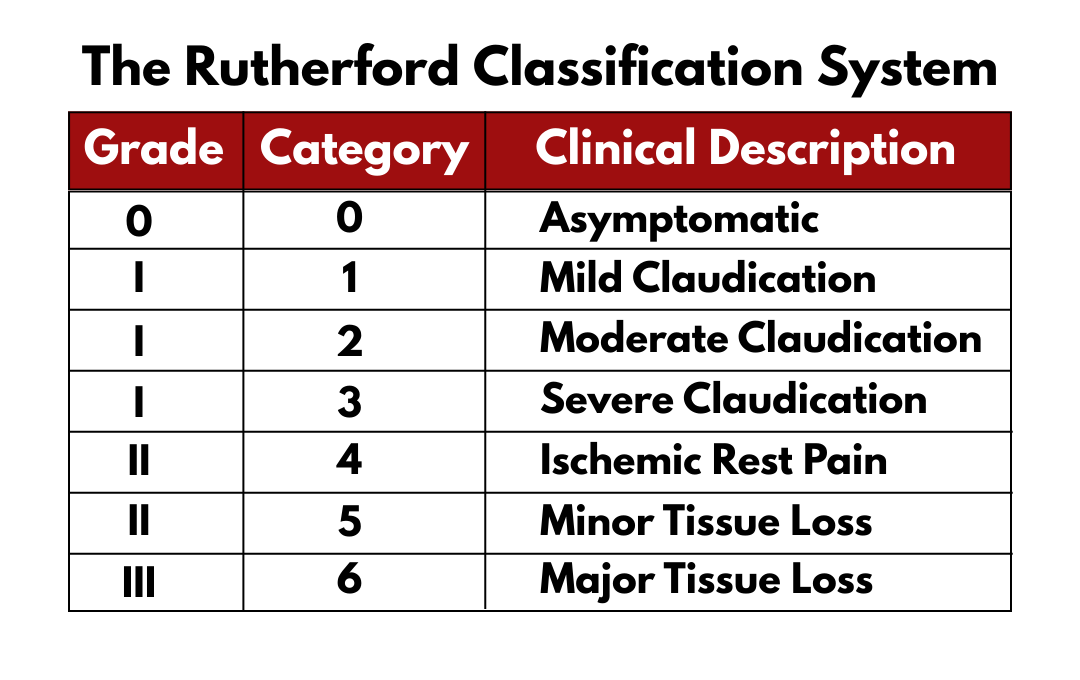
Categories 0–3: Claudication
Claudication is described as calf cramping that flares up while walking and improves with rest. It is often the first sign of PAD. In the Rutherford classification:
- Category 0 – Asymptomatic: Objective evidence of PAD on testing, but no noticeable symptoms.
- Category 1 – Mild claudication: Leg discomfort with walking that does not significantly limit activity.
- Category 2 – Moderate claudication: Walking distance is limited by leg pain.
- Category 3 – Severe claudication: Symptoms significantly restrict daily activities; even short distances may cause pain.
Categories 4–6: Limb-Threatening Ischemia
The Rutherford classification for limb ischemia is categories 4-6. Limb-threatening ischemia, also known as critical limb ischemia (CLI), occurs when plaque in the arteries drastically reduces blood flow and starts to affect the tissues in the legs and feet. CLI indicates that PAD has progressed to more advanced stages and an increased risk of limb loss.
- Category 4 – Ischemic rest pain: Persistent pain in the foot or toes while at rest, often worse at night.
- Category 5 – Minor tissue loss: Non-healing sores or small areas of tissue damage.
- Category 6 – Major tissue loss: Extensive sores or gangrene.
Why PAD Progresses
Every PAD patient is different and may not experience disease progression in the same way. This can depend on various factors that lead to the development and advancement of PAD.
Common risk factors include:
- Age
- Smoking history
- High blood pressure and “bad” cholesterol
- Diabetes
- Family history of vascular disease
Why the Rutherford Scale Matters in PAD Diagnosis
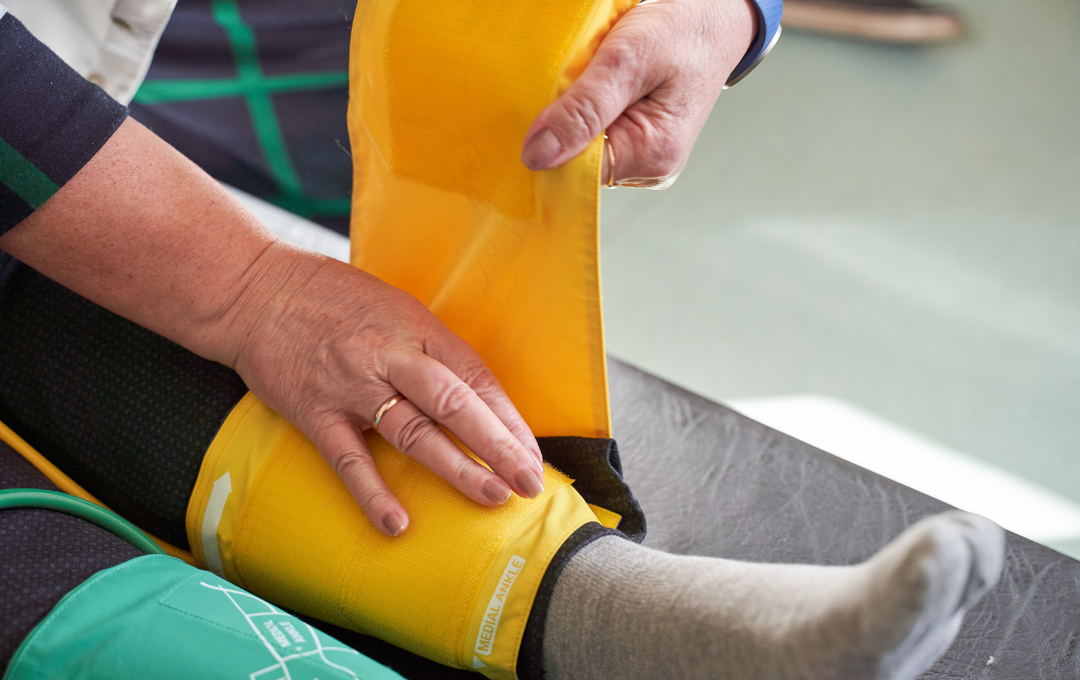
The Rutherford scale provides a standardized way to describe symptom severity, which helps doctors provide patients with an accurate PAD diagnosis. This also helps physicians communicate clearly about disease progression and determine appropriate next steps.
It is used alongside diagnostic tools such as:
- Ankle-brachial index (ABI) testing
- Vascular imaging exams, such as Duplex ultrasound or angiography
- Blood tests
While imaging identifies where blockages are located, the Rutherford classification reflects how those blockages are affecting the limb and how they should be addressed.
What It Means for Patients
For early-stage PAD (Categories 0–2), management emphasizes risk factor modification and structured exercise. The goal is to improve symptoms and reduce cardiovascular risk.
This approach is consistent with established treatment guidelines. In mild to moderate claudication, procedures may not provide additional long-term benefits compared to structured exercise and medical management.
If you are in the Rutherford Category 3, where claudication significantly limits daily life, your provider may discuss revascularization options to improve circulation, walking distance, and quality of life.
In Categories 4 through 6, treatment recommendations become more urgent. Revascularization may still be used in these cases; however, patients with end-stage PAD may need more complex procedures to prevent limb loss.
What It Means for Doctors
For clinicians, the Rutherford classification helps balance risks and benefits.
- In Category 2, placing a stent may expose a patient to procedural risk without clear improvement in outcomes.
- In Category 3, intervention may be appropriate if symptoms persist despite conservative therapy.
- In Category 4 or 5, delaying revascularization may increase the risk of non-healing sores or limb loss.
Using the Rutherford score as a clinical framework supports guideline-based care and helps avoid both overtreatment and undertreatment.
How the Rutherford Score Guides PAD Treatment
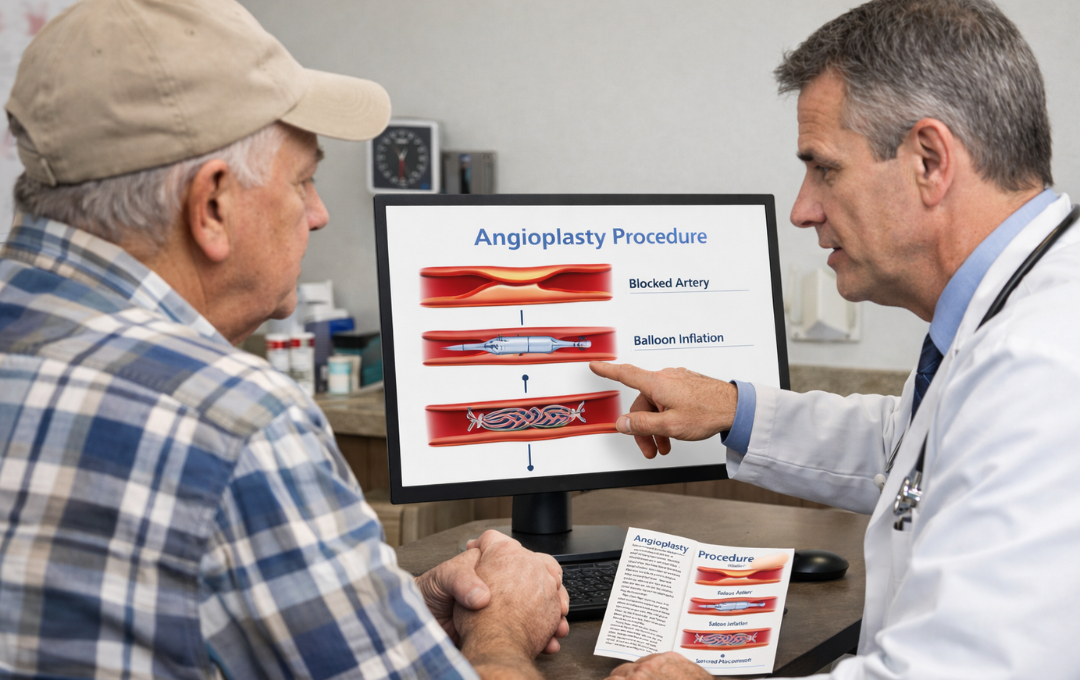
The Rutherford classification framework helps determine whether conservative management, minimally invasive intervention, or more complex surgical care is appropriate.
If you “scored” between 0 and 2 on the Rutherford scale, your provider may recommend conservative treatment first to slow the progression of PAD. This often includes:
- Supervised exercise therapy
- Smoking cessation
- Cholesterol and blood pressure management
- Medications to improve circulation
For Category 3, minimally invasive procedures may be considered when claudication persists despite lifestyle changes. These endovascular techniques are designed to open narrowed arteries and improve blood flow.
Common procedures, which are offered at USA Vascular Centers, include:
- Angioplasty: A small balloon is used to widen narrowed arteries and improve blood flow.
- Stent Placement: A small, mesh metal tube is used to keep plaque compressed to the arterial wall.
- Atherectomy: Specialized devices remove plaque buildup from the arteries.
For Categories 4–6, revascularization is often recommended to relieve ischemic pain and preserve limb function. Minimally invasive procedures may still be used; however, depending on arterial anatomy and overall health, treatment may also include:
- Surgical bypass
- Wound care and infection management
- In advanced cases, amputation may be necessary if tissue cannot be salvaged
PAD Care at USA Vascular Centers
At USA Vascular Centers, physicians focus on diagnosing and treating PAD using minimally invasive, image-guided techniques whenever appropriate. The goal is to restore circulation, relieve symptoms, and support wound healing while minimizing recovery time.
The procedures are offered as outpatient treatments, which allow patients to return home the same day as their treatment. Since these procedures are commonly done through a small, specialized catheter, there is a lower risk of side effects and post-procedural complications.
PAD treatments are tailored to fit each patient’s condition and can be covered by most insurance plans. If patients are unsure about their coverage, USA Vascular Centers can verify the coverage during the scheduling process. Appointments can easily be made online or by calling (888) 773-2193.
For more information about treatment and insurance coverage, or to schedule your treatment, contact USA Vascular Centers today.
Frequently Asked Questions
What is the Rutherford scale?
The Rutherford scale is a clinical staging system used to classify the severity of peripheral artery disease. It ranges from Category 0 (no symptoms) to Category 6 (severe tissue loss).
What is the Rutherford limb ischemia score?
The term Rutherford limb ischemia score refers to the same classification system used to assess the severity of reduced blood flow in the legs, particularly in advanced stages associated with chronic limb-threatening ischemia.
What is the Rutherford scale for claudication?
The Rutherford scale for claudication — calf cramping while walking that stops while resting — is divided into three categories:
- Category 1: Mild
- Category 2: Moderate
- Category 3: Severe
These categories describe the degree to which walking is limited by leg pain and help guide treatment decisions.