
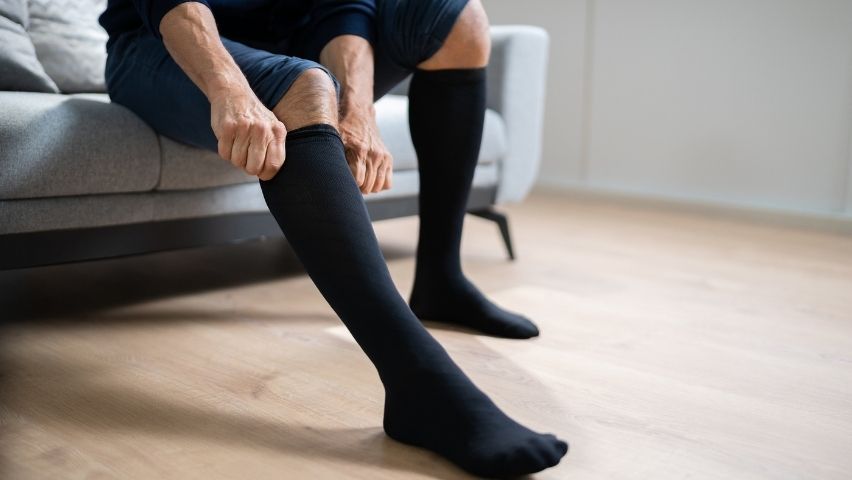
Peripheral artery disease (PAD) often leaves patients searching for effective, non-invasive ways to ease painful cramping and improve blood flow in the lower legs. During this search, compression socks to help with PAD often come to mind as a simple, noninvasive way to improve symptoms. The best compression socks are specialized elastic garments designed to gently compress the legs, primarily to facilitate venous blood (blood traveling in the veins) flow back to the heart.
A critical distinction exists between mild, over-the-counter support socks and prescribed, medical-grade compression stockings for peripheral artery disease. While even the light pressure of store-bought socks can provide relief for venous issues such as swelling (edema) and general fatigue, compression socks for PAD are a subject of significant debate—and often carry risks.
When Compression Socks Help Manage PAD Symptoms
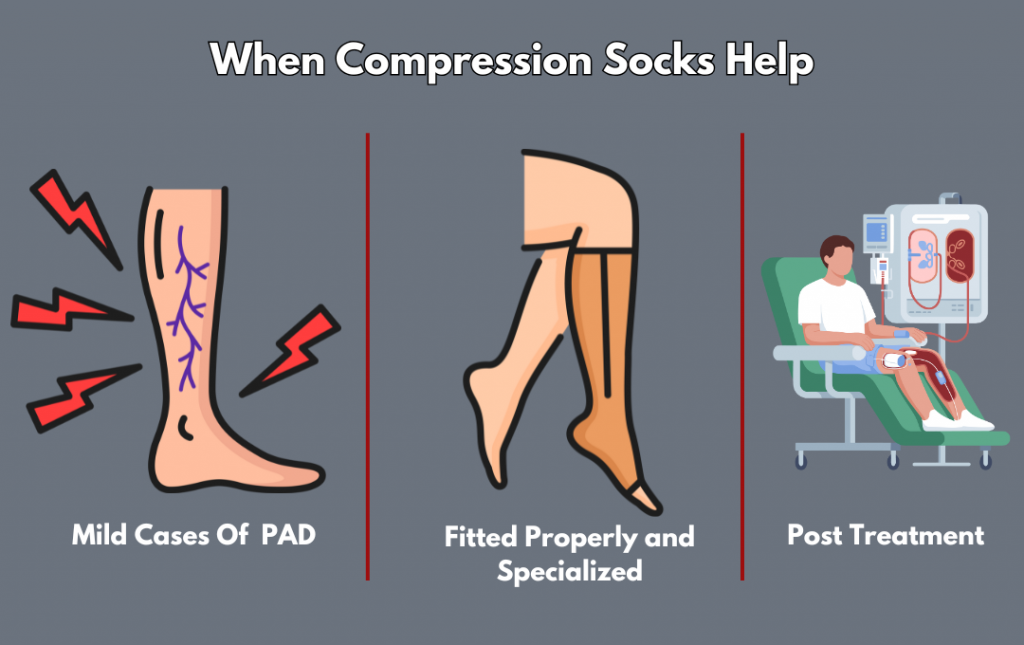
While general use of compression socks for peripheral artery disease (PAD) is not recommended, there are specific, limited circumstances where they may be considered, but only under strict medical supervision:
- Mild Cases and Coexisting Venous Issues: In patients with mild-to-moderate PAD (often defined by an Ankle-Brachial Index [ABI]>0.5), compression therapy or PAD compression socks may be considered to help if they also have a coexisting venous condition (e.g., severe swelling or varicose veins). In these cases, the stockings are used primarily to manage swelling or discomfort associated with vein disease.
- Properly Fitted and Specialized: If compression is determined to be beneficial, the best compression socks for PAD must be properly fitted to prevent further restriction of already limited arterial blood flow. Some specialized stockings are designed with a reverse pressure gradient (higher compression at the calf than the ankle) or use very low pressure (e.g., 15–20 mmHg or less) to minimize arterial risk.
- Post-Treatment Use: Compression therapy often has a role after PAD treatment, such as bypass surgery or angioplasty. In these situations, PAD compression socks may be prescribed to prevent postoperative swelling (edema), thereby reducing pain and lowering the risk of surgical wound infections.
Best Socks for PAD: Finding Temporary Relief While Seeking Medical Advice
If you are wondering, “Should I wear compression socks for PAD?” the answer requires caution. Unlike venous issues where high-compression stockings are a standard treatment, traditional high-pressure compression is often discouraged for PAD. Because PAD involves narrowed arteries that already struggle to deliver blood to the feet, tight compression can further restrict that vital blood flow.
However, specialized socks can provide temporary comfort and essential skin protection while you are waiting for a professional vascular evaluation. These options focus on protection and circulation rather than high pressure:
-
Non-Binding Diabetic Socks: These are the gold standard for PAD. They feature a loose-knit top that stays up without “strangling” the calf or ankle, ensuring that what little arterial blood flow you have is not constricted.
-
Moisture-Wicking Socks: Patients with PAD are at a higher risk for infections due to poor healing. Moisture-wicking fabrics (like merino wool or synthetic blends) keep the feet dry, reducing the risk of fungal growth and skin breakdown.
-
Seamless or Flat-Seam Socks: Even a tiny seam can cause friction against the skin. In a PAD-affected limb, a simple blister from a sock seam can quickly turn into a dangerous, non-healing ulcer. Seamless designs eliminate these “hot spots.”
-
Cushioned Socks: Extra padding on the sole of the foot provides a buffer against micro-trauma and impact, protecting the sensitive tissue of the feet from injury.
-
Antimicrobial Socks: Often infused with silver or copper, these socks help keep bacteria levels low, which is a critical preventative measure against infections in limbs with compromised circulation.
When Compression Socks Can Be Harmful to PAD
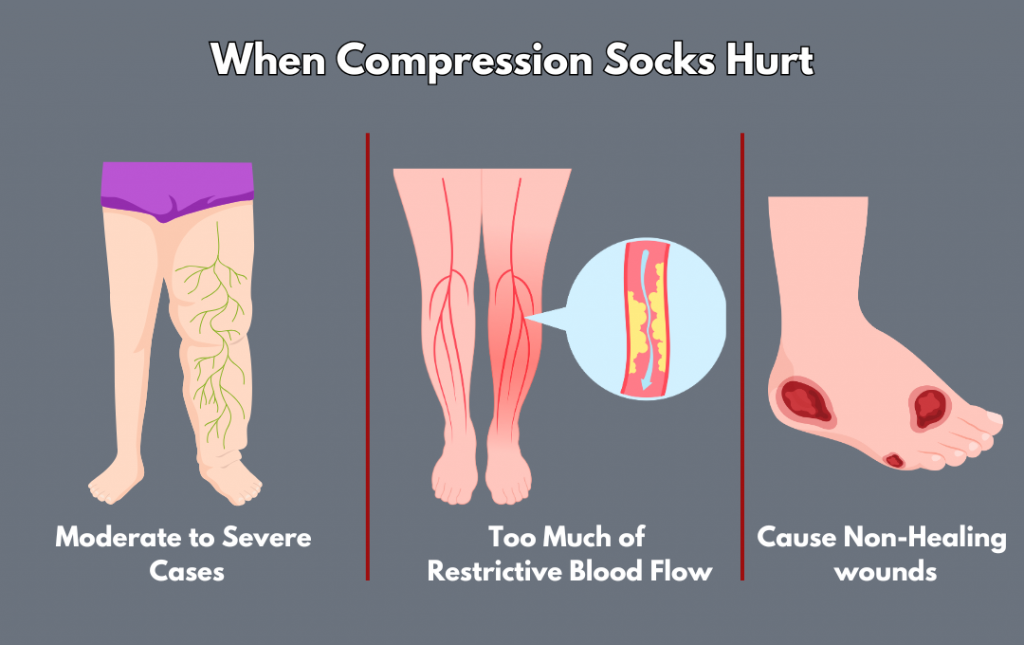
When circulation is already severely compromised, as in moderate-to-severe PAD, compression socks can further reduce oxygen delivery to the tissues.
This restriction carries the risk of:
- Worsening existing pain or numbness.
- Increasing tissue injury.
- Potentially contributing to the development of ulcers or non-healing wounds by starving the tissue of necessary blood and oxygen.
Alternatives to Compression Socks for PAD Symptoms
While the right socks can help manage daily discomfort and protect your skin, the best alternatives to compression socks for PAD Symptoms is to get a consult. Compression socks are a temporary bridge, not a cure. PAD is a progressive disease that requires a medical diagnosis to prevent serious complications like critical limb ischemia or amputation.
If you are experiencing leg pain, heaviness, or cold feet, don’t wait for the symptoms to worsen. Our specialists can provide a non-invasive screening to determine the health of your arteries and create a long-term treatment plan.
Safer and more effective ways to manage peripheral disease with compression socks include:
- Regular walking programs can help new small blood vessels (collateral circulation) form around the blockage, improving blood flow over time.
- Aggressively quitting smoking and managing co-existing conditions like diabetes or high cholesterol can immensely help, as these factors directly contribute to plaque buildup.
- Minimally invasive procedures are the most effective means of relieving symptoms because they directly address the obstruction and offer a longer-term solution.
When to See a Vascular Specialist
If you experience ongoing leg symptoms, it’s critical to seek professional evaluation rather than attempting self-treatment with PAD compression stockings or other compression garments.
- Warning Signs of PAD: Leg pain or cramping when walking (claudication), persistent coldness in the feet, numbness, or wounds that won’t heal are all common signs of PAD.
- Vascular Evaluation: Only a vascular specialist can perform diagnostic tests (such as venous or arterial ultrasound) to accurately assess the status of the arterial circulation. This evaluation will determine if compression is safe or potentially harmful for your specific condition.
Get Relief from PAD Symptoms Without Relying on Compression Socks
PAD compression socks are generally not safe for people with moderate to severe stages. The pressure can compromise the already limited arterial blood supply, leading to serious complications.
If you suspect you have PAD symptoms, do not self-treat with compression socks. The safest course of action is to get a professional vascular evaluation.
USA Vascular Centers offers non-surgical treatment options that are specifically designed to relieve PAD-related leg symptoms and improve circulation by clearing arterial blockages.
Minimally Invasive PAD Treatments
USA Vascular Centers specializes in non-surgical, minimally invasive treatments that restore healthy blood flow through narrowed arteries. These procedures effectively relieve symptoms by addressing the blockage.
- Angioplasty: A balloon is inflated inside the narrowed artery to compress the plaque and widen the vessel.
- Stenting: A small mesh tube (stent) is placed after angioplasty to keep the artery open.
- Atherectomy: Plaque is physically removed from the arterial wall using a specialized device.A vascular specialist will determine what treatment is right for you based on your health.
We are a leading national clinic staffed by highly experienced vascular specialists. Our team includes many board-certified physicians who are dedicated to providing advanced care. We emphasize safe, outpatient, non-surgical treatment options (angioplasty, stenting, atherectomy) that provide long-lasting relief by fixing the problem at the source.
If you have symptoms of PAD or have been diagnosed with diabetes and are concerned about peripheral artery disease, don’t expect compression socks for peripheral artery disease to be a lasting treatment.Instead, schedule an online consultation or call USA Vascular Centers at (888) 7732193 to learn about treatment options that may help alleviate your symptoms. You can visit one of our highly rated locations throughout the US to receive the care you need.
FAQs About Compression Socks and Peripheral Artery Disease
Is there a difference between compression socks and compression stockings for PAD?
There is a difference between compression socks and compression stockings for PAD, but it is primarily in length, not safety. Compression socks typically cover the foot and calf, or may extend above the knee or to the thigh.For patients with PAD, the compression level (mmHg) is more important than the length. PAD patients must use caution with any type of PAD compression socks, as external pressure can be risky.
What are the best socks for peripheral artery disease?
In most cases, the “best” socks for peripheral artery disease is no compression unless specifically directed by a vascular specialist. If used at all, they must be:
- Low-pressure: Socks with a low-pressure gradient (typically 15–20 mmHg maximum).
- Physician-fitted: They must be measured and fitted by a medical professional.
- Used short-term: Typically used only for specific indications and monitored closely.
Always follow medical guidance before using any compression garment
Are there signs that compression socks are making my PAD worse?
- There are signs that compression socks are making my PAD worse, with common symptoms such as: Increased pain or cramping in your feet or calves while resting.
- Worsening numbness or tingling in your toes or feet.
- A change in the color or temperature of your feet (e.g., feet becoming paler or colder).
- Any sign of skin breakdown or new sores on your feet or legs.
If you are using compression socks for PAD and experience any of the symptoms above, you should immediately remove them and consult your specialist.
What is the difference between using compression socks for PVD vs. PAD?
While they both affect the legs, Peripheral Venous Disease (PVD) and Peripheral Artery Disease (PAD) require opposite approaches to compression.
-
For PVD (Venous): High-pressure compression stockings are usually recommended. In PVD, your veins have trouble sending blood back up to your heart. Compression helps “squeeze” the veins to move blood upward and reduce swelling.
-
For PAD (Arterial): Traditional high-pressure compression can be dangerous. In PAD, your arteries are already narrowed and struggling to get oxygen-rich blood down to your feet. Tight compression can act like a tourniquet, further restricting that limited blood flow and increasing the risk of tissue death.
What is the Rule for PAD Patients About Wearing Compression Socks?
If you have PAD, you should avoid “off-the-shelf” high-compression socks. Instead, look for specialized socks designed for protection and moisture management rather than pressure:
-
Non-binding diabetic socks (to prevent constriction)
-
Seamless or padded socks (to prevent blisters/ulcers)
-
Moisture-wicking materials (to prevent infection)
-
Important Safety Note: Because the wrong type of sock can worsen arterial blockage, you should only use these as a temporary comfort measure while waiting for a medical evaluation. If you are experiencing leg pain or heaviness, schedule a vascular consultation immediately to determine your specific circulation needs before starting any compression therapy.