

Peripheral artery disease (PAD) is a condition in which plaque builds up in the arteries of the legs and feet. This plaque can block blood flow to the lower extremities, leading to pain, numbness, and weakness in the legs.
A Peripheral Artery Disease (PAD) test is a diagnostic procedure used to check for reduced blood flow in the arteries of your legs, which could be a sign of PAD. PAD occurs when the arteries become narrowed or blocked, usually by fatty deposits, which restricts blood flow to your limbs and can cause symptoms like pain, cramping, or numbness.
For individuals over age 50 or with any PAD risk factors, a peripheral artery disease test is recommended for timely diagnosis and intervention. If you’ve never been tested for this vascular condition, here’s what you can expect.
How To Test for PAD
A proper evaluation by a vascular professional is needed to confirm a diagnosis and determine appropriate treatment. Self-screening methods are not always reliable or accurate ways to monitor for PAD at home.
USA Vascular Centers has a team of experienced vascular specialists who perform comprehensive testing for PAD and create personalized treatment plans tailored to each patient’s symptoms and health goals.
Call Now to Schedule a PAD Test
Non-Invasive to Advanced Tests for Peripheral Artery Disease
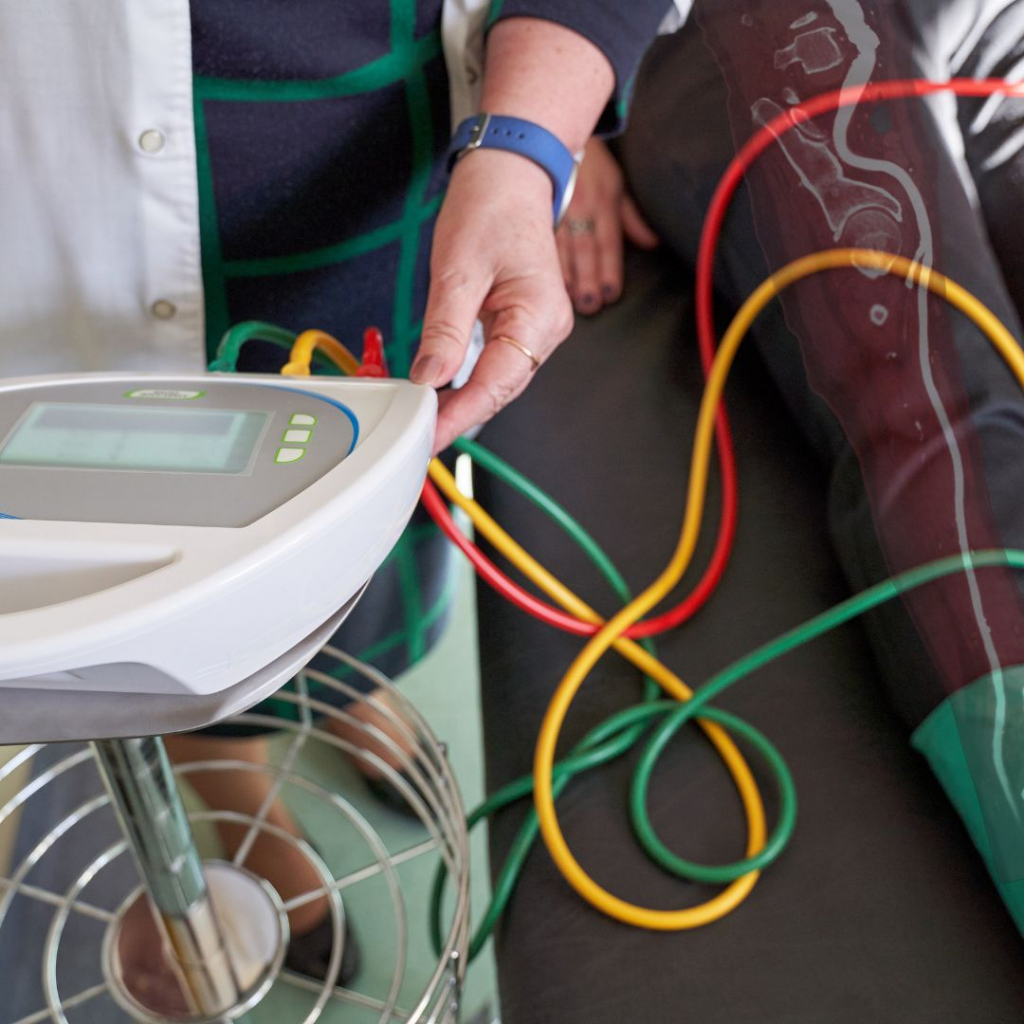
If you have any warning signs or PAD risk factors, a doctor may recommend one of several non-invasive advanced tests. During the physical inspection of the PAD test, the doctor will examine your feet and legs for surface-level signs of PAD, including ulcers, wounds that aren’t healing, and changes in skin color or temperature. The strength of the two pulses that should be present in each foot is also evaluated. If they believe a peripheral artery disease test is needed, they may recommend one of the following:
Ankle-Brachial Index (ABI) — Primary PAD Screening Test
An ankle-brachial index test is a widely used method for detecting signs of PAD. To perform the ABI test, the doctor will wrap a blood pressure cuff around your ankle and arm. The doctor will then inflate the cuff and measure the blood pressure in each location. The ABI is calculated by dividing the ankle blood pressure by the arm blood pressure.
Toe-Brachial Index (TBI) — When ABI May Be Unreliable
Older patients or patients with diabetes are more likely to produce higher ankle pressure with an ABI test because of arterial calcification. In these cases, a TBI might be recommended over an ABI. This PAD test compares pressure between the toe and the arm and is used to identify blockages or narrowing in smaller digital arteries.
Doppler/Duplex Ultrasound — Flow and Velocity Mapping
Ultrasounds can be used to diagnose PAD by looking for narrowing or blockages in the arteries. It can also be used to measure blood flow in the arteries. This information can help your doctor determine the severity of your PAD and whether you need treatment. Ultrasound is a safe and painless procedure. It is often used as a first-line test for PAD because it is non-invasive and does not require any radiation.
Exercise (Treadmill) ABI — Unmasking Exertional Symptoms
This PAD test uses an ankle-brachial index test on patients while walking on a treadmill. During the test, a resting ABI is measured before and after the patient walks on a treadmill. Adding a treadmill exercise to the test can help identify intermittent claudication. This approach is often recommended for individuals who have a normal ABI test result but are still exhibiting PAD symptoms.
Segmental Pressures & Pulse Volume Recording (PVR)
A pulse volume recording test is used to detect arterial blockages by measuring arterial blood flow in the legs. During the PAD test, a blood pressure cuff is placed on different parts of the leg. As the cuff is inflated, waveforms are recorded and assessed. A vascular doctor will then compare the waveforms between the thigh, calf, and ankles to identify blockages.
Advanced Imaging: CTA, MRA, and Catheter Angiography
MRA and CTA are angiography diagnostic imaging tests that a vascular doctor may recommend to visualize the arteries. A CTA is a CT angiography that can be used to identify the location of the arterial blockages, and an MRA is a magnetic resonance angiography used to measure blood flow. These are non-invasive peripheral artery disease tests that are typically used for diagnostic mapping.
A catheter angiography, also called an angiogram or arteriogram, is a minimally invasive test that can help doctors diagnose peripheral artery disease (PAD). It uses a small catheter, X-ray imaging, and a contrast dye to pinpoint the location of an arterial blockage.
The catheter is inserted into a blood vessel, typically in the groin or arm. Contrast dye is then injected to make the blood vessels visible on X-ray. This allows the physician to pinpoint the exact location and severity of arterial blockages. The procedure is usually done under local anesthesia, so you will be awake during the test.
Blood Tests and Supporting Diagnostics
Depending on your symptoms, a vascular specialist may also recommend blood tests and labs to measure lipids, triglycerides, or identify inflammatory markers. However, labs alone cannot identify blockages or fully diagnose PAD. They can only identify risk factors or provide more information about your overall health after a physiologic test is performed.
Understanding PAD Test Results
After an ABI test, a vascular specialist will discuss the results with you. Here’s how the results are interpreted.
|
ABI Testing Results |
Interpretation |
|
> 1.30–1.40 |
Non-Compressible/Calcified is often referred to as Abnormal. |
|
1.0 – 1.29 |
Normal |
|
0.91 – 0.99 |
Borderline PAD |
|
0.41-0.90 |
PAD (Mild to Moderate) |
|
< 0.40 |
Severe PAD |
If the results are abnormal, the arteries may be too stiff for an accurate ABI. In this case, a TBI or further testing may be recommended.
After the diagnostic test for peripheral artery disease is complete, a vascular specialist will discuss the results with you. If the test shows PAD is present, they’ll develop a custom treatment plan tailored to your condition. Treatment plans and recommendations will vary by patient and depend on the severity of the diagnosis.
Why PAD Testing Matters for Long-Term Health
Peripheral artery disease is a progressive disease that requires medical intervention to slow the progression. Without treatment, the disease can progress to end-stage PAD, increasing your risk of gangrene, which is the death of body tissue. When left untreated, gangrene can lead to amputation. It’s critical to catch PAD in the early stages and start a treatment plan to address symptoms, so pay attention to your body’s signals and seek help if you suspect you may have PAD.
Treatment Options After Testing for Peripheral Artery Disease

At USA Vascular Centers, our team of vascular specialists offers three minimally invasive peripheral artery disease (PAD) treatments:
- Angioplasty: A catheter is used to insert a balloon into the narrowed artery. The balloon is then inflated to widen the artery. This is a minimally invasive treatment that helps restore blood flow and offers instant relief from PAD symptoms.
- Stent placement: After angioplasty, a stent is inserted into the artery to keep it open. Stents are small, mesh tubes that help to keep the artery walls from collapsing. This keeps the artery open and helps prevent future blockages from forming.
- Atherectomy: A catheter with a blade or laser is used to remove plaque from the artery. Physically removing plaque can help remove stubborn blockages and restore blood flow in the artery.
After PAD testing, your doctor will review your results, discuss these treatment options, and determine which is best for you.
Comprehensive PAD Testing and Care at USA Vascular Centers
Our advanced diagnosis and treatment programs can help improve your quality of life and reduce PAD complications. If you need testing for PAD, we encourage you to schedule a consultation with one of our vascular doctors online or by calling us at 888.773.2193 today.
FAQs for Peripheral Artery Testing
Can medications affect PAD test readings?
Certain medications can affect the test results. Inform your vascular doctor about any prescriptions or over-the-counter medications you’re currently taking before the test.
How soon are PAD test results available?
For standard, non-invasive tests often performed right in the clinic, such as the Ankle-Brachial Index (ABI), which uses blood pressure measurements, and Doppler Ultrasound, the results are often available immediately or within the same visit. The doctor will typically be able to discuss preliminary findings with you right away.
If your vein specialist requires any additional blood work or specialized lab work (for example, to check cholesterol or diabetes levels that may be contributing factors), those results will need processing time. In these cases, results may take approximately three to five business days.
Are PAD tests safe if I have a pacemaker or stent?
Most peripheral artery disease tests are non-invasive and safe for patients with a pacemaker or stent. A vascular doctor will determine which is the best test to use, depending on your medical records.