
Medically reviewed by
USA Clinics Medical Review Team
Vascular Health Education Experts
Reviewed: September 2026
Arteries carry blood away from your heart, and veins carry it back. That one-way traffic pattern shapes almost everything else about how these two blood vessels are built and how they work. Understanding the difference can help you recognize when leg pain, swelling, or other symptoms point toward a circulation problem worth checking out.
What Is an Artery?
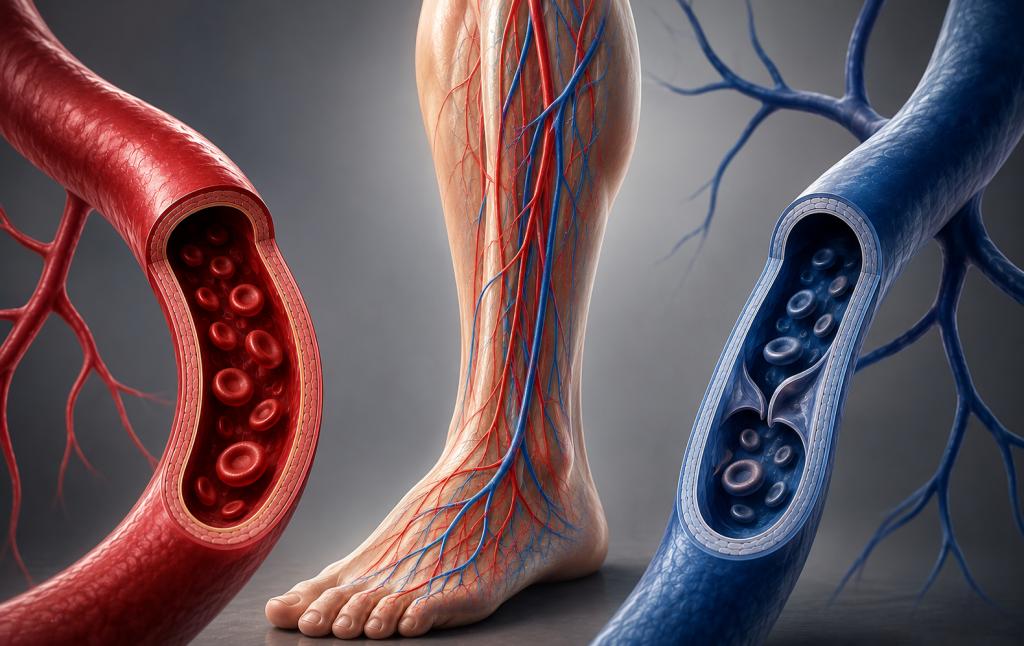
Arteries are blood vessels that carry oxygen-rich blood away from your heart to the rest of your body. Because they carry blood under high pressure straight from each heartbeat, artery walls are thick and muscular. That thickness helps them handle the force of each pump without stretching too much.
Most arteries sit deep within muscle tissue, protected from everyday bumps and pressure. The largest artery in the body, the aorta, branches into smaller and smaller arteries until they reach every organ, muscle, and cell that needs oxygen.
Artery Structure
An artery wall has three layers. The inner layer is smooth so blood can move easily. The middle layer is thick muscle that can tighten or relax to control blood flow. The outer layer is tough connective tissue that holds everything in place.
What Is a Vein?
Veins are blood vessels that carry oxygen-poor blood back to your heart and lungs, where it picks up fresh oxygen again. Veins do not have to fight the heart’s pumping pressure, so their walls are thinner than artery walls.
Because blood in the legs has to travel upward against gravity to get back to the heart, veins in the lower body rely on one-way valves. These valves open to let blood move up and close to stop it from sliding back down. Leg muscles help too. Every time you walk or flex your calf, the movement squeezes nearby veins and pushes blood along.
Veins sit closer to the skin’s surface than arteries in most parts of the body, which is why you can often see them in your arms, hands, and legs.
What Happens When Vein Valves Weaken
When vein valves stop closing properly, blood can pool in the legs instead of moving efficiently back to the heart. Over time, this pooling can lead to visible, swollen veins and a feeling of heaviness or aching in the legs.
Arteries vs. Veins: Key Differences
- Direction of blood flow – Arteries carry blood away from the heart. Veins carry blood back to the heart.
- Oxygen level – Arteries typically carry oxygen-rich blood. Veins typically carry oxygen-poor blood, except for the pulmonary vessels, which work the opposite way.
- Wall thickness – Artery walls are thicker and more muscular to handle higher pressure. Vein walls are thinner.
- Valves – Most veins have one-way valves to keep blood moving toward the heart. Most arteries do not need valves because heart pressure keeps blood moving forward.
- Location – Arteries usually run deep within muscle tissue. Veins are often closer to the skin’s surface.
- Blood volume – Veins hold a larger share of your total blood volume at any given moment, since their thinner walls allow them to expand and store more blood.
Are Arteries Deeper Than Veins?
Generally, yes. Most arteries travel deep within muscle tissue, which helps protect them since they carry blood under higher pressure. Veins are often more superficial, especially in the arms and legs, which is part of why they are easier to see and why blood draws typically use a vein rather than an artery.
Is an Artery More Important Than a Vein?
Neither is more important than the other. Arteries and veins work as a team. Arteries deliver the oxygen and nutrients your tissues need, while veins carry away waste products and return blood to be reoxygenated. If either system stops working well, the other cannot compensate. A problem with arteries, like peripheral artery disease (PAD), and a problem with veins, like chronic venous insufficiency, both affect circulation, just in different ways.
What Happens if You Hit an Artery Instead of a Vein?
Arteries carry blood under much higher pressure than veins. An injury to an artery can cause blood to spurt out forcefully and can lead to significant blood loss quickly, which is considered a medical emergency. A cut or puncture to a vein usually bleeds more slowly and steadily, since venous pressure is lower. This is also why healthcare providers typically draw blood from a vein rather than an artery, since it is safer and easier to control.
Where Do Capillaries Fit In?
Capillaries are the smallest blood vessels in the body, and they connect arteries to veins. Blood moves from arteries into a network of capillaries, where oxygen, nutrients, and waste products are exchanged with surrounding tissue. From there, blood collects into veins to begin its trip back to the heart. Arteries, veins, and capillaries work together as one continuous circulatory loop.
Why Understanding This Difference Matters for Your Health
Recognizing whether a circulation symptom may be arterial or venous can help you describe it more clearly to a doctor and get the right evaluation sooner. Leg pain that shows up during walking and eases with rest can be a sign of leg pain caused by PAD, a condition caused by narrowed arteries. Leg swelling, aching, or visible bulging veins are more often linked to venous issues like chronic venous insufficiency.
If you are noticing leg pain, cramping, or other new circulation symptoms, a vascular specialist near you can help sort out whether the issue involves your arteries or veins.
Vascular health check
Understand your PAD risk before symptoms progress.
Knowing the difference between arteries and veins is a helpful first step, but ongoing leg pain, cramping, or circulation changes deserve a closer look. A vascular specialist can help determine whether arterial narrowing may be contributing to your symptoms.
Frequently Asked Questions
- Cleveland Clinic. “Peripheral Artery Disease.” my.clevelandclinic.org/health/diseases/17357-peripheral-artery-disease-pad
- Mayo Clinic. “Peripheral artery disease (PAD) – Symptoms and causes.” mayoclinic.org/diseases-conditions/peripheral-artery-disease/symptoms-causes/syc-20350557
- Centers for Disease Control and Prevention. “Peripheral Arterial Disease (PAD).” cdc.gov/heart-disease/about/peripheral-arterial-disease.html
Medical disclaimer: This content is provided for educational purposes only and is not a substitute for professional medical advice, diagnosis, or treatment. Always consult a qualified vascular specialist regarding any questions about your circulatory health.