

Medically reviewed by
USA Clinics Medical Review Team
Vascular Health Education Experts
Reviewed: August 2026
Erectile dysfunction (ED) can be one of the earliest PAD symptoms of poor circulation, sometimes showing up before leg pain or cramping does. This makes it a warning sign worth paying attention to, not just a normal part of aging.
Peripheral artery disease (PAD) happens when plaque builds up inside your arteries. This narrows the space blood needs to flow through. This buildup, called atherosclerosis, does not stop at the legs. The same narrowed arteries that limit blood flow to your calves and feet can also limit blood flow to your pelvis. That includes the arteries that supply the penis. When blood flow drops in that area, it becomes harder to get or keep an erection.
Research shows a strong association between erectile dysfunction and vascular disease, which is why persistent ED may warrant evaluation for underlying cardiovascular risk.
How PAD and Poor Circulation Can Cause Erectile Dysfunction
An erection needs a fast, healthy increase in blood flow. Arteries narrowed by plaque cannot move blood fast enough. This can happen even when the rest of your circulation seems fine. That is why some men notice erection changes before they notice any claudication, or leg pain with walking. Claudication is the symptom most people link to PAD.
Many men also do not connect the two conditions right away. Erectile dysfunction is often treated as a separate issue, unrelated to the arteries in your legs and feet. But the arteries in your body are part of one connected system. If plaque is building up in one area, it is often building up in others too. Erectile dysfunction related to reduced arterial blood flow may therefore be an early warning sign of vascular disease elsewhere in the body.
Why Does PAD Give Me ED?
The arteries that supply the penis are smaller than the arteries in your legs. This means they may narrow from plaque sooner. Doctors believe endothelial dysfunction is the likely shared cause behind both PAD and ED. This happens when the inner lining of your blood vessels does not relax and expand the way it should.[1] Because of this link, doctors now view erectile dysfunction as a possible early sign of artery disease throughout the body.[2]
Is Erectile Dysfunction Always a Sign of PAD?
No. Stress, certain medications, hormone changes, and other health issues can also cause ED. But the link between ED and PAD is strong enough that it should not be ignored. One large study using national health data found that men with ED had about twice the odds of also having PAD.[3] This held true even after adjusting for other risk factors like diabetes, high cholesterol, and smoking. PAD often causes no clear leg symptoms in its early stages. This means erectile dysfunction may be one of the only visible clues you have that circulation is a problem.
What Test Checks for PAD If I Have Erectile Dysfunction?
The ankle-brachial index, or ABI test, is the standard screening tool for PAD symptoms, and it is non-invasive. It compares blood pressure in your arm and your ankle to check for narrowed or blocked leg arteries. In one well-known study, 45 percent of men being tested had erectile dysfunction. Of that group, 23 percent also had peripheral artery disease found through the ABI test.[4] Of the men who had PAD, 66 percent had no leg symptoms at all before testing. This is why screening matters, even if your legs feel fine.
Can Treating PAD Improve Erectile Dysfunction?
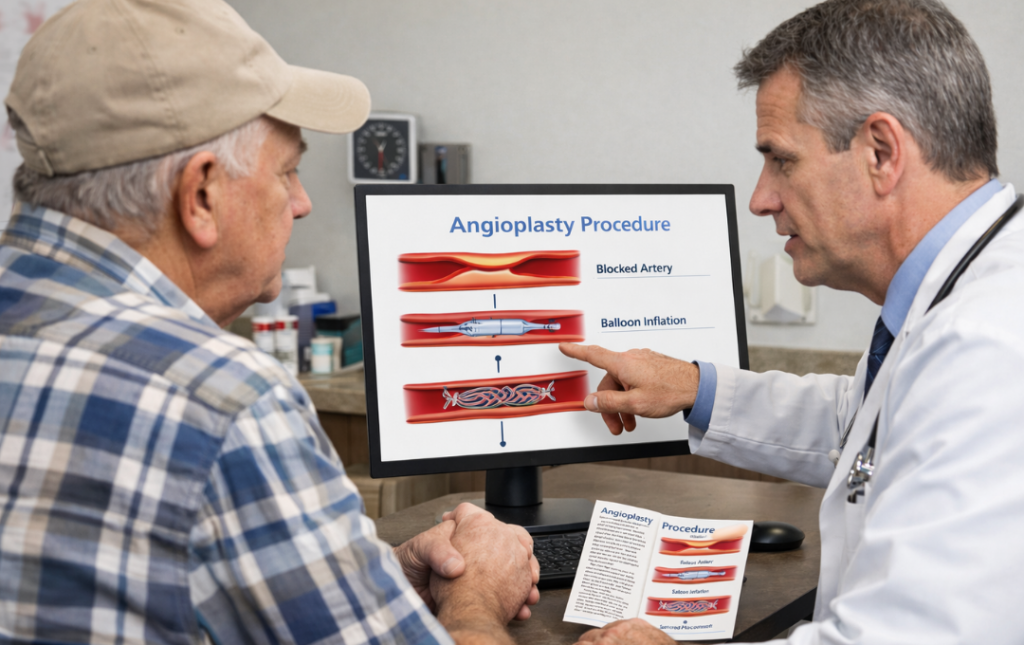
When narrowed arteries are part of the problem, improving blood flow may also help improve erectile function. Vascular specialists often recommend lifestyle changes first, such as quitting smoking and staying more active. They may also prescribe medication to support healthy blood flow. For patients whose PAD requires intervention, minimally invasive procedures such as angioplasty or stent placement may be used to restore blood flow through affected arteries. Some research suggests that improving vascular blood flow may also improve erectile function in certain patients.[5] Results vary from person to person, and PAD treatment is not a guaranteed treatment for ED because other factors may also be involved.
Should I See a Vascular Specialist or a Urologist First?
This is one of the most common questions men ask, and the answer depends on your symptoms and risk factors. If you have ED along with PAD risk factors, such as smoking, diabetes, high cholesterol, or a family history of vascular disease, a vascular specialist can perform testing such as an ABI to check for signs of PAD and determine whether poor circulation may be contributing to your symptoms. If another cause is suspected, a urologist can evaluate other factors that may contribute to erectile dysfunction.
At What Age Does PAD-Related ED Usually Start?
There is no single age when this begins. It depends on your own risk factors more than your age alone. That said, research shows the link between ED and PAD is strongest in men over 50, especially those who smoke or stay less active.[3] Men who smoke, have diabetes, or have high cholesterol may notice circulation-related changes earlier, sometimes in their 40s. For more context on differences between men and women, see how gender can affect PAD risk.
Understanding how PAD progresses over time shows why catching these changes early matters. Early action gives you more treatment options and a better shot at keeping your mobility and quality of life.
Next step
Understand your PAD risk before symptoms progress.
If you have erectile dysfunction along with PAD risk factors or other symptoms of poor circulation, a vascular evaluation can help determine whether reduced blood flow may be contributing.
FAQs About PAD Symptoms and Erectile Dysfunction
Take the Next Step Toward Better Circulation
Erectile dysfunction can feel like an awkward topic to bring up. But when it is tied to poor circulation, it is also a warning sign worth paying attention to. If you have persistent ED along with PAD risk factors or symptoms of poor circulation, screening can help identify PAD before it progresses and causes more serious symptoms.
USA Vascular Centers provides PAD screening and minimally invasive treatment at locations nationwide. Schedule a consultation to better understand your circulation and explore treatment options if PAD is detected.
- Kloner, R.A. (2013). The link between vasculogenic erectile dysfunction, coronary artery disease, and peripheral artery disease: role of metabolic factors and endovascular therapy. PubMed 23735361.
- Peripheral Arterial Disease. StatPearls, NCBI Bookshelf. NBK430745.
- Association of erectile dysfunction and peripheral arterial disease in NHANES 2001-2004: a cross-sectional study. Frontiers in Endocrinology, 2024. PMC11576202.
- The association between erectile dysfunction and peripheral arterial disease as determined by screening ankle-brachial index testing. PubMed 19501825.
- Benaragama, K.S., et al. (2020). Erectile Dysfunction in Peripheral Vascular Disease: Endovascular Revascularization as a Potential Therapeutic Target. PubMed 32840461.
Medical disclaimer: This content is provided for educational purposes only and is not a substitute for professional medical advice, diagnosis, or treatment. Always consult a qualified vascular specialist regarding any questions about your circulatory health.