Medically reviewed by
USA Clinics Medical Review Team
Vascular Health Education Experts
Reviewed: August 2026
A scar that will not heal properly on your leg or foot can be a sign of peripheral artery disease (PAD), a condition in which narrowed arteries limit the blood flow your skin needs to repair itself. PAD does not just slow healing on the surface. It can also cause scarring inside the artery walls themselves, which narrows the vessel further and compounds the problem.
We will cover why PAD interferes with normal wound healing, how the arteries themselves can develop their own type of scar tissue, what signs may point to PAD rather than ordinary slow healing, and when a vascular evaluation is the right next step.
What Causes Slow Scar Healing With PAD
Healthy wound healing depends on a steady supply of oxygen-rich blood reaching the injured tissue. That blood carries oxygen, nutrients, and the immune cells needed to fight infection and rebuild skin. When peripheral artery disease narrows the arteries that feed your legs and feet, less of that blood reaches the wound site.
This is why even a minor cut, blister, or surgical incision can turn into a slow-healing wound in someone with PAD. The tissue around the wound may not receive enough oxygen to complete the normal stages of repair, so healing stalls or the wound may lead to a chronic, non-healing sore.
Wound healing normally moves through a few overlapping phases: an initial inflammatory response, the formation of new tissue and collagen, and a longer remodeling phase where the scar gradually strengthens. Each of these phases is oxygen-dependent. When circulation is reduced, the inflammatory phase can drag on longer than it should, new tissue may form unevenly, and the remodeling phase may never fully complete. The result is a scar that stays fragile, thin, or prone to reopening long after a typical wound would have closed.
Reduced circulation is also associated with claudication, the muscle cramping many people notice while walking, which is often the first sign that prompts someone to ask about PAD.
People with PAD are also more prone to infection at the wound site. Immune cells travel through the bloodstream, so reduced blood flow means fewer of these cells reach the area to fight off bacteria. A wound that becomes infected on top of already-limited circulation can be slower to heal and more likely to develop complications, which is part of why prompt evaluation matters when a wound is not progressing as expected.
How Arterial Scarring and Poor Circulation Affect Your Skin
Scarring with PAD can happen in two different places, and it helps to understand both.
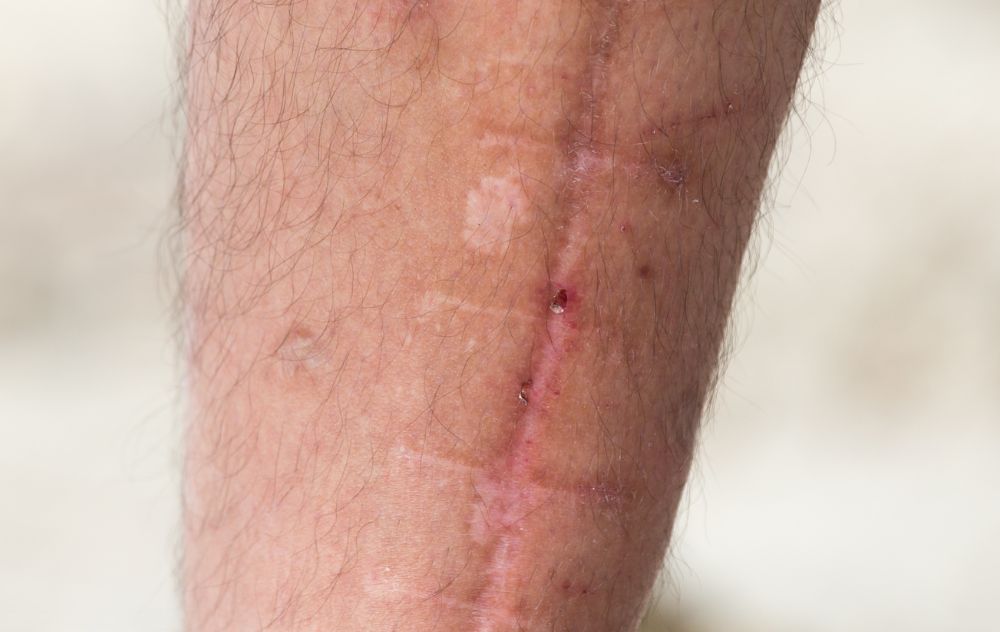
The first is skin-level scarring, the visible mark left after any wound heals. Scar tissue is less flexible than normal skin and can look thinner, tighter, or discolored compared to the surrounding area.
The second is arterial scarring, which happens inside the blood vessel itself. Conditions such as high blood pressure can create small tears in the smooth inner lining of an artery over time. As this lining scars and roughens, it becomes easier for plaque, made of fat, cholesterol, and other substances, to stick to the artery wall. This buildup is called atherosclerosis, and it is the most common underlying cause of PAD.
Because PAD can restrict blood flow beyond the legs, it may also affect sexual function in men. PAD can cause erectile dysfunction when narrowed arteries limit the circulation needed for an erection.
Understanding your PAD symptoms and how they connect to this narrowing process is often the first step toward getting an accurate diagnosis.
Once an artery has narrowed enough, less blood reaches the tissue downstream, which is what makes ordinary skin wounds and scars so much harder to heal in someone with PAD.
This overlap explains why scarring and PAD are connected in two directions at once. A wound heals more slowly because circulation is already reduced, and the underlying arterial disease that caused that reduced circulation continues to progress unless it is identified and addressed. Recognizing a slow-healing scar as a potential symptom, rather than dismissing it as ordinary healing time, is often what leads to an earlier PAD diagnosis.
Signs Your Non-Healing Wound or Scar May Signal PAD
Most scars fade and heal within a matter of weeks. A wound or scar that behaves differently may be worth discussing with a vascular specialist. Watch for:
- Slow closure: A wound that has not started to close after two to three weeks.
- Skin color and temperature changes: Skin around the wound that looks pale, dusky, or unusually cool to the touch.
- Persistent redness or warmth: A scar or wound edge that stays red, warm, or tender well beyond the normal healing window.
- Unusual drainage: Drainage that has an unpleasant odor or an unusual color.
- Wounds without a clear cause: Sores on the toes, heels, or lower leg that appear with little or no obvious injury.
These signs, especially when paired with leg pain that comes and goes with activity, may be associated with more advanced circulation problems and are worth a prompt evaluation rather than waiting to see if the wound resolves on its own.
Treatment Options to Support Circulation and Wound Healing
If PAD is confirmed as a factor in a slow-healing wound or scar, treatment focuses on restoring blood flow to the area so the tissue can heal normally. At USA Vascular Centers, our specialists may recommend angioplasty, stent placement, or atherectomy, depending on where the narrowing is located and how severe it has become.
These are minimally invasive, outpatient procedures performed through a small incision, which is different from surgical arterial revascularization and generally involves less downtime.
Lifestyle changes, such as quitting smoking and managing blood pressure, cholesterol, and blood sugar, can also help support healing and may help slow the progression of PAD over time. A vascular specialist can help determine which combination of approaches is appropriate for your specific case.
Wound care itself typically continues alongside vascular treatment. Keeping the area clean, protected, and monitored for signs of infection remains important even after blood flow has improved, since previously affected tissue can take time to fully recover its normal healing capacity. Many patients notice that once circulation is restored, new wounds and scars begin to heal at a more typical pace, which can be one of the more encouraging signs that treatment is working.
Next step
Heal the Wound. Address the Source.
A slow-healing scar may be telling you something your circulation cannot say out loud. A vascular specialist can evaluate whether PAD is behind your wound or scar and outline options tailored to your circulation.
Frequently Asked Questions About Scar Healing and Circulation
- National Heart, Lung, and Blood Institute (NHLBI), National Institutes of Health. “Peripheral Artery Disease – Causes and Risk Factors.” nhlbi.nih.gov
- American Heart Association. “What Is Peripheral Artery Disease?” heart.org
- Wernick B, Nahirniak P, Stawicki SP. “Impaired Wound Healing.” StatPearls [Internet]. National Library of Medicine, National Institutes of Health. ncbi.nlm.nih.gov/books/NBK482254/
Medical disclaimer: This content is provided for educational purposes only and is not a substitute for professional medical advice, diagnosis, or treatment. Always consult a qualified vascular specialist regarding any questions about your circulatory health.